
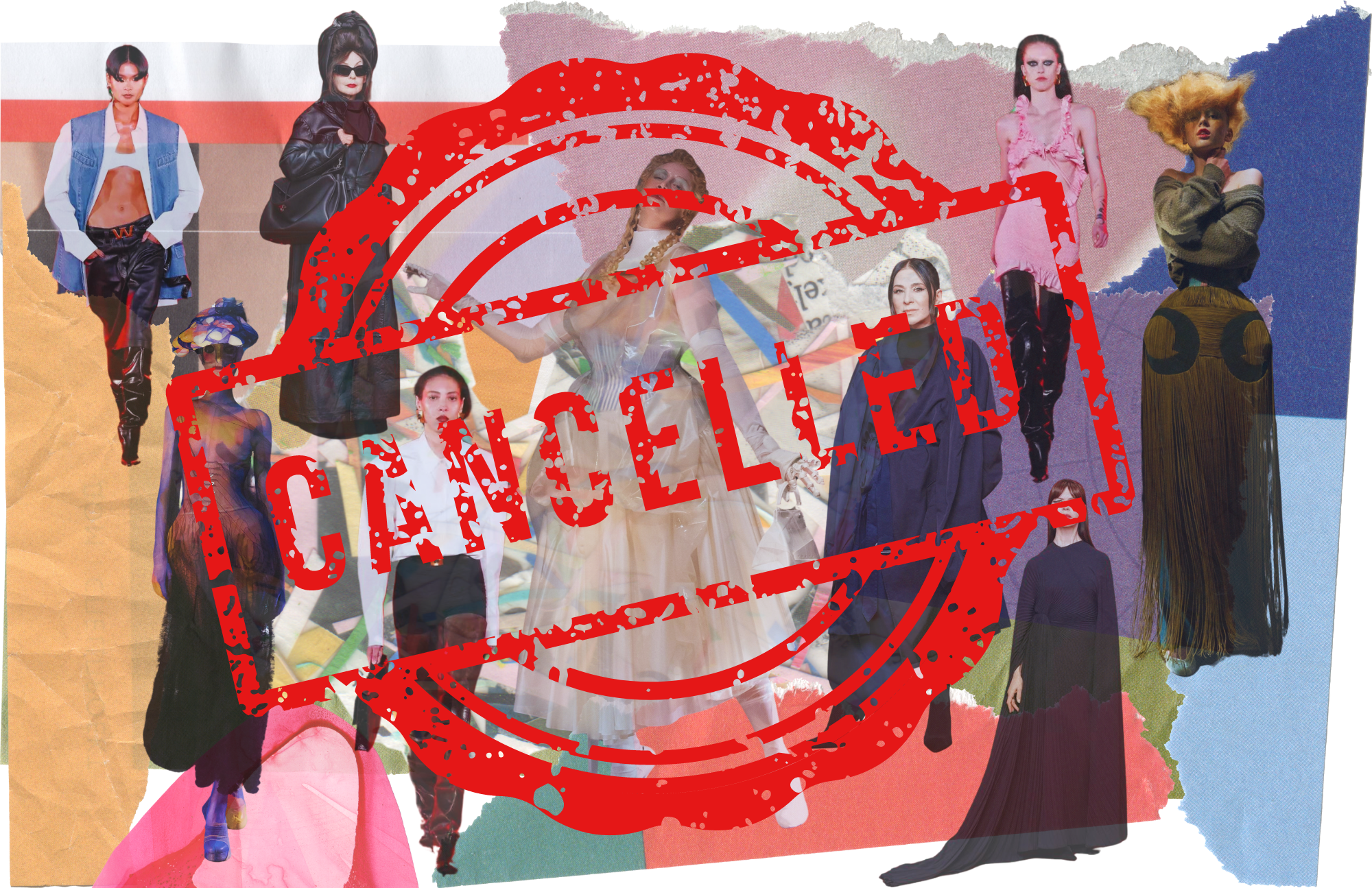
Haute couture fashion week was over a fortnight ago, but I haven’t been able to stop thinking about it! Not for the reasons one might assume, though. While there were innovative and impressive collections, my only thoughts were on Balenciaga.
Balenciaga, a French luxury line started in 1919, gained notorious virality in 2022 that the brand can’t seem to escape. After multiple controversies (that we will cover momentarily), the brand lost mass market appeal. Even long-time celebrity supporters, like Kim Kardashian, found Balenciaga’s multitude of “mistakes” too egregious to ignore. Yet, the long-standing brand remains a pillar in the fashion industry. So much so, that their latest collection debuted during Haute Couture week of 2024.
Once I saw Balenciaga’s name on the schedule for Haute Couture week, I immediately lost my excitement. From ethics to innovation, cancelation can force a brand, and industry, to change in many ways. Yet, the fashion industry, and it’s giants, have stayed the same; even at the cost of mass market appeal (or at the cost of their ideal market, I should say).
Still, I held on to hope! I couldn’t help but wonder, did the momentary cancelation force innovation to the forefront? Perhaps Balenciaga was debuting never-before-seen designs that would leave me speechless. Maybe that’s why this infamous brand was included yet again; their new-found creativity would be their saving grace. Alas, I was wrong.
Balenciaga’s Most Controversial Scandals
By now, we all know the dumpster-fire that was Balenciaga’s holiday ad campaign. It featured children holding teddy bears clad in what appeared to be BDSM bondage gear.
Shortly after, the brand released another ad that featured legal papers from the Supreme Court case United States v. Williams, a lawsuit that revolved around child pornography laws. Additionally, two books were featured: Matthew Barney’s The Cremaster Cycle, and Michaël Borremans’ As Sweet as It Gets. Artnet.com describes the former book as “images from Barney’s eponymous five-part film series, a complex masterwork of avant-garde cinema populated with macabre creatures and abstruse sexual metaphors.” While the latter artist, “is known for unsettling imagery, particularly his 2018 series Fire from the Sun, which depicts “toddlers engaged in playful but mysterious acts with sinister overtones and insinuations of violence,” according to his New York dealer, David Zwirner.“
When asked about the campaign’s intended vision, Balenciaga’s creative director Demna told Vogue Paris they were referencing “punk and DIY culture”.
Balenciaga Ad Conspiracy Theory
While I don’t personally have a conspiracy theory regarding Balenciaga’s poor decisions, trust that many exist. Prior to researching the brand, though, I’ll be the first to admit that some of the conspiracy theories sounded like a realistic possibility.
However, after educating myself on the eye-brow raising history of Balenciaga, this campaign seems on par. By that I mean, this French luxury brand is known for being “edgy” and “pushing the boundaries” of fashion- even if it sends a harmful message. In my opinion, the 2022 holiday ad fiasco was Balenciaga’s latest attempt at doing just that.
The brand’s once thought-provoking and unique creative direction now comes off as a cheap shot to procure shock value.
For instance, Balenciaga’s creative director Demna Gvasalia has a history of well-documented controversy prior to joining the French house’s team. Demna was, first, the co-creator of Vetements, a Swiss luxury fashion house. However, some of his best work for the brand also happens to be one of his biggest controversies! Demna loved the ‘bootleg’ movement, and strived to incorporate it into his own designs. By 2016, he would achieve this with Vetements’ infamous DHL logo top. Shortly after, Demna would make an Ikea 50p Frakta bag dupe for Balenciaga that would retail for $2,150. While these bootleg collections did stir debates over intellectual property rights, it would not be his undoing. That would come in 2019, when he would be forced to resign from Vetements after public backlash for his ‘poverty chic’ movement. This would not have any effect on his position at Balenciaga, though.
It seems Demna’s polarizing creative direction is actually the exact reason he was sought after in the first place. With that in mind, which scenario seems most likely: Balenciaga’s holiday ad was merely another attempt at controversy to stir up public attention or was Balenciaga trying to subtlety advertise their covert trafficking ring to the world?
In my opinion, their goal from the beginning was to release a polarizing campaign, and that is exactly what they achieved. The same way Charlie XCX used neon green as the sole eye-catching element for Brat’s cover art, is the same way Balenciaga intended to use bondage gear. Why neon green? Because it’s such a blindingly bright color that it demands your attention, yet it is a color rarely used due to its polarizing nature. Why bondage gear on teddy bears? Because it takes a commonly used item and starkly contrasts it with a taboo eye-sore.
The difference between Balenciaga and Charlie XCX, though? The pop star made her controversial choice trendy. I’ve never seen as many neon green lovers as I have in the summer of Brat.
Balenciaga’s 2024 Haute Couture Collection
With Balenciaga attempting a comeback (though I fear they already have), I was expecting their new collection to give me a reason why.
Aside from the obvious capitalist reasons that we all chose to pretend aren’t the driving force behind a business, I was expecting Balenciaga’s new collection to show why their vision matters and try. Whether that meant trying to appeal to a new demographic, trying out-there designs, or trying new color schemes, I wasn’t sure. But, nonetheless, I expected an exuberant amount of effort- especially for haute couture week.
But, I was left sadly mistaken.
Balenciaga showed the same designs in the same colors in the same routine way they always have.

Canceled Fashion Brands
Balenciaga’s lackluster collection left my original question without answer. Does cancelation force innovation, and is that enough to salvage public standing? If not, what saves a brand from societal exile?
These questions first popped into my head when the 2023 Met Gala theme was announced. Karl Lagerfeld: A Line of Beauty. Surely, we had to be honoring the Chanel brand, right? Not the racist, misogynistic, fatphobic former creative director? But, then again, Chanel was founded by a Nazi, no? Perhaps Lagerfeld represents exactly what the brand originally stood for.
But, again, even after the event and all of the interviews born from it, I was left with no direct answer to my original question.
By now, though, I could ascertain that, in society’s eyes, one’s creative genius truly is their saving grace. While Karl Lagerfeld was a despicable human being, he is memorialized as “the creative powerhouse behind the modern revival of Chanel” according to Britanica.
This ascertain did not quell my curiosity, however. Instead, it fed the fire within me, prompting me to wondering: how far will we go to excuse horrible behavior for the sake of beauty?
Dolce & Gabbana Scandals
Before Kourtney Kardashian had a Dolce & Gabbana themed wedding, I could see the almost forgotten brand rising from the ashes of cancelation. After the Barker’s bash, I knew D&C had successfully cemented themselves as an industry powerhouse once again.
What had been their downfall in the first place, though? Dolce & Gabbana had never peaked my interest (however I do believe that’s because they had mostly fallen out of the general public’s favor by the time I had gained internet access), so I didn’t know what exactly had caused their demise.
To my surprise, Dolce and Gabbana made many heinous comments. Please keep in mind, when I say Dolce and Gabbana, I’m not talking about the overall brand. I am talking about the Dolce and Gabbana; the creators who retain control over the company, and its creative direction, to this day.
The creators have a long history of racism within the brand and without. From claiming that Chinese people eat dogs to selling “Slave Sandals” and Blackamoor earrings, D&C have made their ideology crystal clear personally and professionally.
Dolce has also referred to children born from IVF as “synthetic”, and both creators have condemned the use of surrogacy.
Isn’t that ironic since their saviors from cancelation used surrogacy themselves? Kim Kardashian partnered with D&C for a collection that had an extremely successful runway debut. Khloé Kardashian is a loud and proud longtime public supporter who wore the brand’s designs for the entire weekend. In fact, the whole Kardashian-Jenner family did!
Aside from an apology by Dolce over his “synthetic” comment, I could find no mention of either creator making amends for the previously mentioned controversies.
Alexander Wang Scandals
In 2020, Alexander Wang was accused of sexual assault by 11 models; some of which even alleged they had been drugged. While Alexander Wang had vehemently denounced the accusations at the time, he has since given an interview with Puck journalist Lauren Sherman. In it, he explained how “[his] lifestyle wasn’t hospitable to real intimacy and didn’t allow room for deeper connections. Even though [he] was in these situations where [he] felt like it was casual, [they’re] having fun, but that might not [have been] the feeling of someone else.”
If you were to analyze his interview in an English class, one might surmise that he is still excusing his actions by explaining how he thought it was all casual. But, I am not an English teacher, and the public found that to be an acceptable answer rather than a way to escape accountability. In fact, one could argue the public never really found the accusations unacceptable in the first place. Revenue remained unaffected, and NBC News reports Alexander Wang was “greeted with adoration during his highly anticipated show” after taking just a short two year break.

Maison Margiela Scandals
Maison Margiela is a unique brand for many reasons- one of my favorite being that it has an unproblematic creator. Unfortunately, though, Maison Margiela would leave his brand in 2008 due to investor differences. Still, the brand managed to steer clear of controversy. That is, until they hired John Galliano in 2014 as creative director.
Galliano originally worked as the creative director of Dior, but was fired in 2010 after screaming anti-Semitic vitriol in a Paris bar. Kevin Macdonald would go on to make a documentary in an attempt to uncover the reason behind Galliano’s madness, but the answer would be less than fulfilling. The creative director says he was “blind drunk, blacked out” and “doesn’t even remember why he did it”.
Reuters reports that Galliano has since “undergone treatment for drugs and alcohol, and [even] worked briefly as a designer for New York fashion brand Oscar de la Renta in 2013” before joining the team at Maison Margiela.
In an interview with APnews, Macdonald explains that, while the designer does seem to be sorry about what happened, he thinks “[Galliano’s] a bit narcissistic, and [that the designer] feels like, you know, “I’ve done enough.” But of course, then [Galliano will] turn around and say, “Well, I know that I’m never going to be forgiven. And I know that there’s certain people who would never buy my clothes.”
Can You Be UnCanceled?
To be completely transparent, when I began writing this article, I was a firm believer in cancelation being a one-and-done type of deal.
Words, at the end of the day, are just words. If a beloved figure reveals themself to be a racist bigot, why are we so quick to believe public outrage is all it takes to completely re-wire their way of thinking?
Hateful ideology is deep rooted. It is something you’re taught from birth, and unless you actively seek other ways of thinking or living, you’ll never know anything else.
Actions speak louder than words. From my research, Galliano is the only one who took action. Through Maison Margiela, Galliano is the only designer listed in this article to actually contribute something new to world of fashion after a major controversy.
As a matter of fact, Galliano’s vision for Maison Margiela’s Spring ‘24 collection was so mind blowing, that I still think about it to this day! It is also the inspiration behind this article. Shortly after Margiela’s Spring ‘24 collection debuted, I learned of Galliano’s past and I was heartbroken.
I had never been faced with such conflicting emotions. As I said, once something has been rightfully canceled, it’s near impossible to gain me back as a consumer. You couldn’t convince me that the canceled’s remorse was anything more than concern for their own profit. With no real remorse, and nothing new to offer, why would I want to choose a canceled brand?
But Galliano did offer me something new. And not only was it new, it was interesting and beautiful and haunting. The fashion industry, as well as those outside of it, even agreed too!

While that’s wonderful, I suppose, it also left me confused. Did this make it okay to shop Galliano’s collections now? We welcomed all the aforementioned brands, who showed far less remorse, back in with eager arms and far more fanfare.
What’s the criteria to make a successful comeback? And why have we let so many, despite so little effort?
At what point do we stop giving leeway to brands and creators who have shown no regard for the implications of their actions? At what point do we say your talent is not worth the suffering you’ve caused?
I’m not just talking about physical suffering either! Whether it’s creative work that toes the line of infringement or despicable actions of a brand representative, we as a society must begin to consistently weigh the risk vs reward.
A Brand’s Saving Grace
For the average consumer, I think it’s safe to say that a brand’s creativity and innovation is their saving grace from cancelation. However, for the haute couture consumer, I think it’s a brand’s exclusivity that saves them from cancelation.
While the class system may look different depending on the culture you’re observing, one universal indicator of a person’s socioeconomic status is their ability to have what few do.
Fashion brands are a perfect example of this- especially Balenciaga! The French luxury house did not change their aesthetic or marketing strategy or production model, even after cancelation. They continued acting as if they were still the go-to for elites, almost as if their cancelation had simply increased their exclusivity rather than placed them in exile.
Soon, celebrities began to adopt that same attitude. Instead of remembering why Balenciaga was disgraced, they saw an opportunity to be front and center on Page Six, as well as a chance to win best-dressed on Instagram polls. After all, society never stopped liking Balenciaga because they thought their clothing fell off!
Leave a Reply